Accord for software teams
Accord is a requirements tracker with QA built in, and it drives the coding agent you already pay for to implement the work. It runs on your own machine, and nothing is ever marked done until a person has tested it.
npx rekall-accord
Free for seven days. No card, no sign-up, nothing to uninstall.
How it works
The client is certain they asked for something. You're certain they didn't. You're three weeks into building the other thing. Accord is for the part either side of the code, where that argument is won or lost.
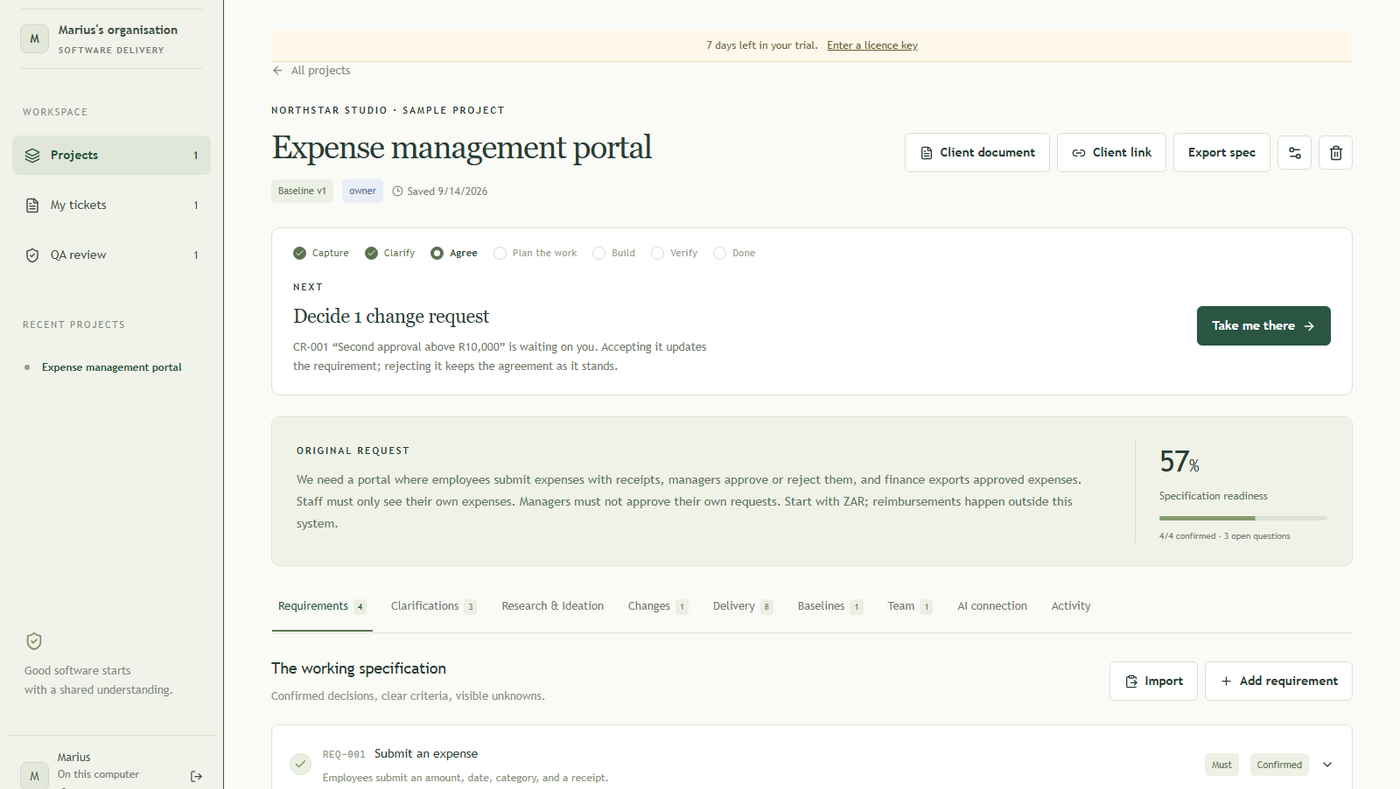
Requirements carry acceptance criteria, which is the bit everyone skips. Once a baseline is approved, anything new arrives as a change request against it, with the before and after side by side. You can still say yes to everything. You just end up with a record of it.
Tickets come off the requirements and carry the criteria with them. Approve one, hand it to your agent, and it implements it in your repository, runs what tests it can, and reports back with the files it touched and evidence against each criterion. You review the real diff, not a summary of it.
Every requirement produces two tickets: one to build and one to verify. The verification sits at "waiting for a tester" until a person records a pass or fail against every criterion. The agent never signs off its own work, and neither does the owner without the results.
Inherited a codebase?
Point Accord at a repository you already have. Your coding agent reads it and writes up what the system currently does, as requirements with acceptance criteria and the file paths each one came from, so you can check its working.
A four-project .NET solution, surveyed in an afternoon. Every requirement came back with acceptance criteria describing behaviour that exists today.
Every path it cited was checked and existed. You are not reading a plausible story about your code, you are reading something you can verify line by line.
It also worked out that the repository did not build from a clean clone, because an ignore rule was quietly excluding two source files. That had been true for months.
Your agent, your account
Accord never calls a model itself and does not resell anyone's tokens. It starts the coding agent already installed on your machine, under your own account, and records which agent and model every run executed under.
The two most common coding agents, driven directly. Accord detects whichever you have installed and tells you on first run.
Kimi Code CLI runs as its own agent. GLM runs through Z.ai's Anthropic-compatible endpoint. Your key stays on your machine.
Run a model on your own hardware through Codex CLI's open-source mode. Accord lists the models you have actually pulled.
Plainly: your code goes to whichever agent you run, on your own account, exactly as it does today. It does not come to us. We do not see it, store it, or pass it anywhere.
Try it free
The trial starts the first time you run it. Nothing is collected, there is no account to create, and if it isn't for you there is nothing to uninstall.
npx rekall-accord
Needs Node 22 or newer, and your own coding agent. $29 a month after the trial.
Reading is always free. If a licence lapses, every project, requirement and test result stays exactly where it is and stays readable. What stops is making changes.